Water is the single largest ingredient in almost every beverage, from bottled water and soda to juice, tea and plant-protein drinks. Yet water treatment is one of the most underestimated parts of a new production plant. Get it wrong and you face inconsistent taste, scaled-up equipment, membrane damage, and — worst of all — microbiological risk. Get it right and you have a stable, safe, great-tasting base that lets everything downstream perform. This guide explains the core stages of beverage-grade water treatment and how to design a system that fits your product and your local water source.
Every water source is different. Municipal supplies vary by season, borehole water carries minerals and hardness, and surface water brings organic matter and turbidity. That is why there is no single universal treatment recipe — the right design always starts with a water analysis and a clear definition of the finished-water target.
1. Pre-Filtration: Removing Particles and Turbidity
The first stage removes suspended solids, sediment and turbidity that would otherwise foul downstream equipment. This typically uses a multi-media filter containing layers of graded sand and gravel, sometimes preceded by a coarse mechanical filter for very turbid sources.
- Purpose: protect membranes and downstream stages from fouling
- Removes: sand, silt, rust, suspended particles
- Key point: correct backwash design keeps the media clean and effective over time
2. Activated Carbon Filtration: Taste, Odour and Chlorine
Activated carbon adsorbs chlorine, organic compounds and the off-tastes and odours that would ruin a beverage. Removing chlorine is also essential to protect RO membranes, which are damaged by oxidisers.
- Purpose: improve taste and odour, remove chlorine and organics
- Removes: chlorine, chloramines, organic matter, colour
- Key point: carbon must be replaced or regenerated on schedule to stay effective
3. Water Softening: Controlling Hardness
Hard water, high in calcium and magnesium, causes scale that damages boilers, heat exchangers and RO membranes. A softener uses ion-exchange resin to swap hardness ions for sodium, protecting equipment and stabilising the process.
- Purpose: prevent scaling and protect equipment
- Removes: calcium and magnesium hardness
- Key point: sizing must match both water hardness and flow rate, with automatic regeneration
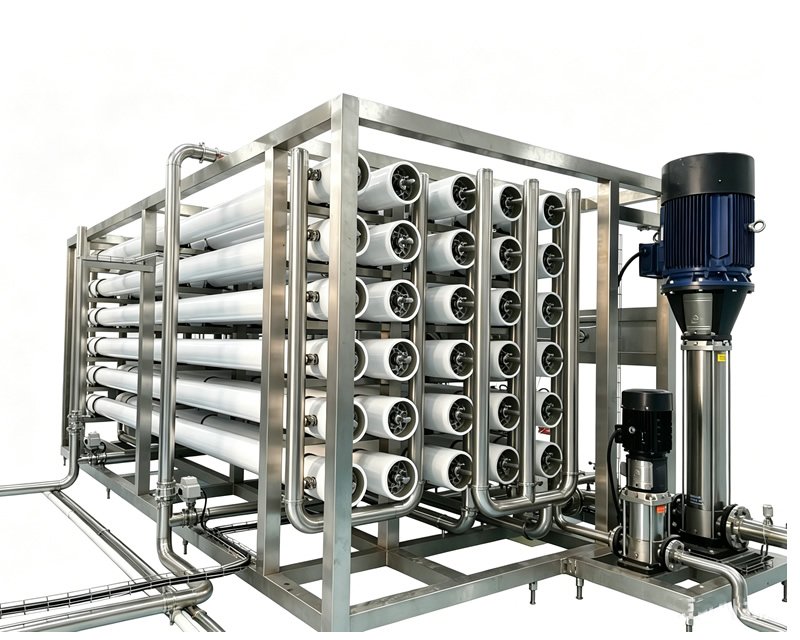
4. Reverse Osmosis (RO): The Heart of the System
Reverse osmosis is the core purification stage for most beverage plants. High pressure forces water through a semi-permeable membrane, leaving dissolved salts, minerals and contaminants behind. The result is consistent, low-TDS water that gives you full control over the final recipe. Many plants use a two-stage RO system for higher purity and recovery.
- Purpose: produce consistent, purified low-TDS base water
- Removes: dissolved salts, minerals, most contaminants, up to 99% of TDS
- Key point: pre-treatment quality determines membrane life; monitoring TDS ensures stable output
5. Sterilisation: UV and Ozone
Purified water must be microbiologically safe and stay that way through filling. UV sterilisation destroys microorganisms as water passes through, while ozone provides residual protection in storage tanks and during bottling. Together they form a robust double barrier essential for shelf stability and consumer safety.
- Purpose: guarantee microbiological safety
- Methods: UV for instant kill, ozone for residual protection
- Key point: ozone dosing and contact time must be validated for your bottle and product
Designing the Right System for Your Plant
The correct configuration depends on three things: your source water analysis, your product type, and your target output. A pure bottled-water plant may need the full chain ending in careful mineral balancing, while a soda plant prioritises neutral, stable base water for consistent flavour. A plant on hard borehole water needs robust softening; one on chlorinated municipal water needs strong carbon filtration. Sizing every stage to the same flow rate prevents bottlenecks and ensures the system runs smoothly at full capacity.
This is why water treatment should never be an afterthought bolted onto a filling line. It should be engineered as an integral part of the whole production system, sized and matched to everything downstream.
Talk to an Engineer About Your Water
The best water treatment design starts with your actual water report and your finished-product goals. Our engineering team designs turnkey beverage lines with water treatment built in from the ground up — so your base water is stable, safe and perfectly suited to your product, wherever your plant is located.
Not sure what water treatment your plant needs? Explore our Complete Beverage Production Line Solutions.
Related reading: explore our turnkey project cases across water, soda, juice, tea and plant protein beverages.